Split-gill
Schizophyllum commune
| Kingdom | Fungi |
| Class | Agaricomycetes |
| Order | Agaricales |
| Family | Schizophyllaceae |
| Genus | Schizophyllum |
| Species | S. commune |
Split-gill
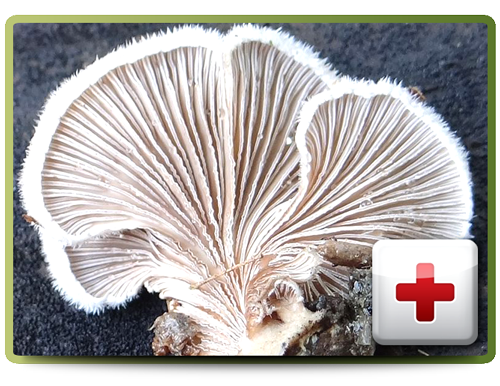
The Split-gill holds a remarkable scientific status: it is one of the most widely distributed fungi on earth, found on dead wood on every continent except Antarctica, and has been studied for its extraordinary genetic complexity — it has approximately 23,000 distinct mating types. The split gills that give it its name fold closed in dry conditions and reopen when wet — a survival mechanism unique in the fungal kingdom.
The primary medicinal compound, schizophyllan (SPG) — a (1→3)-beta-D-glucan — has been studied in clinical trials in Japan for cervical cancer treatment. Schizophyllan has shown immunomodulatory activity through Dectin-1 and Dectin-2 receptor engagement, and has demonstrated synergistic effects when combined with radiotherapy. The cosmopolitan distribution and year-round availability make it a subject of ongoing bioprospecting interest.
Bioactive Compounds & Medicinal Properties
| Schizophyllan (SPG) | Beta-glucan studied in cervical cancer clinical trials in Japan |
| Immune activation | Dectin-1 and Dectin-2 receptor engagement — innate immune stimulation |
| Antifungal paradox | Immunocompromised individuals: opportunistic pathogen; immunocompetent: immune stimulant |
| Hydration polymer | SPG forms hydrogel — studied in drug delivery and cosmetics |
| Distribution | Most cosmopolitan mushroom on earth — researched across multiple continents |
| Preparation | Aqueous extract; not a culinary mushroom due to tough texture |